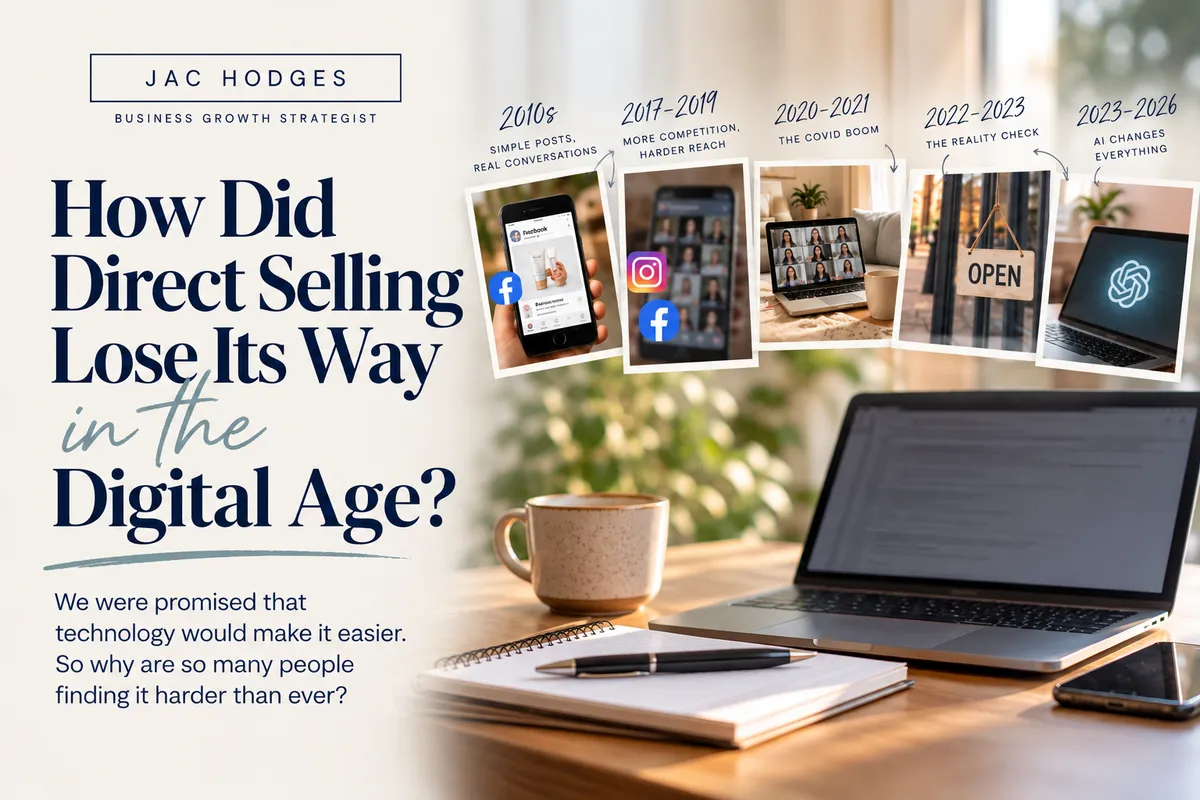
How Did Direct Selling Lose Its Way in the Digital Age?
We were promised that technology would make building a Direct Selling business easier. So why are so many people finding it harder than ever?
I've spent over 20 years working in Direct Selling, and I've watched the industry go through some extraordinary changes.
I've seen the excitement of social media opening up completely new opportunities. I've watched businesses embrace e-commerce, digital training and online communities. I've seen the extraordinary growth that happened during COVID, and more recently, the explosion of AI.
And through all of it, one question keeps coming back to me.
Have we actually made it easier for people to build a successful Direct Selling business, or have we just given them more things to do?
When posting a product was enough
Cast your mind back to the early days of Facebook.
You could post a photograph of a product, share a little story about it, and people would comment, ask questions and buy.
It wasn't particularly sophisticated. You didn't need to understand algorithms, video editing, content pillars, SEO or engagement strategies.
You just needed something worth sharing and people who were interested.
For many Direct Sellers, social media was transformational.
Suddenly, your business wasn't limited to the people you could meet face-to-face. You could connect with customers, build communities and grow teams in ways that hadn't previously been possible.
It was exciting, accessible and, for a while, relatively straightforward.
But things started changing.
When visibility became a full-time job
As social media grew, so did the competition for attention.
Organic reach became less predictable. Platforms introduced new formats. Video became increasingly important. Algorithms evolved, and what worked yesterday didn't necessarily work tomorrow.
The simple act of posting a product photograph was no longer reliably generating the same response.
And the advice to the field?
Post more. Be consistent. Try Reels. Go live. Improve your hooks. Learn the algorithm.
People who had joined Direct Selling because they loved products, customers and helping others suddenly found themselves trying to become digital marketers.
Some adapted brilliantly.
Others were left wondering why they were spending more time creating content and getting fewer results.
They weren't necessarily doing less. They were just getting less back.
The industry's response: more tools, more training, more content
To be fair, Direct Selling companies recognised that their field needed help.
So they invested.
Digital asset libraries. Social media graphics. Content calendars. Online training academies. Replicated websites. Apps. Social selling workshops.
All designed to make life easier.
But here's where I think we need to ask some uncomfortable questions.
How much of that training was actually developed and tested by people who had successfully built a Direct Selling business online themselves?
There is a difference between understanding digital marketing and understanding how an independent Direct Seller builds a customer base.
A corporate marketing department has resources, budgets, brand awareness and specialist skills.
An independent distributor might have a phone, a couple of hours in the evening and a genuine desire to earn some extra income.
Those are very different starting points.
And giving thousands of people identical graphics and captions doesn't necessarily help them stand out. In some cases, it simply makes everyone look the same.
We taught people how to post.
But were we teaching them how to find customers, develop relationships, generate repeat business and build something sustainable?
I'm not convinced we always were.
Then COVID happened, and everything changed again
For many Direct Selling businesses, the pandemic brought extraordinary growth.
People were at home. Shops were closed. Social lives moved online. Digital communities became more important, and online shopping accelerated dramatically.
Products that might previously have been sold through demonstrations, events and personal appointments were suddenly being discovered and purchased online.
For some businesses and distributors, sales soared.
And I think something happened during that period that we haven't talked about enough.
We started believing those conditions were normal.
We assumed that because people were buying online in extraordinary numbers, they would continue doing so.
We celebrated the growth, quite rightly.
But did we properly distinguish between businesses growing because they had developed brilliant digital customer acquisition strategies and businesses benefiting from an unprecedented change in consumer behaviour?
Because those are not the same thing.
Then the world reopened.
People went back to work, shops, holidays, restaurants and their normal routines.
Household spending came under pressure. Competition for attention intensified.
And suddenly, the online sales that had seemed almost effortless for some were much harder to generate.
The conditions had changed.
But in many cases, the advice hadn't.
Keep posting. Keep showing up. Keep sharing.
And when the results didn't follow, people started questioning themselves.
Along came AI. Surely this was the answer?
Then generative AI arrived, and for a moment, it felt like the playing field had finally been levelled.
People who struggled to write captions could suddenly produce them in seconds.
People who couldn't design graphics could create beautiful visuals.
Content calendars, video scripts, marketing ideas and entire campaigns became accessible to almost anyone.
And initially, that was genuinely exciting.
But here's the problem.
When everybody has access to the same advantage, it stops being much of an advantage.
Now we have an enormous volume of polished, professional-looking content.
Beautiful graphics. Perfect captions. Carefully constructed hooks.
And yet plenty of business owners are still struggling to generate meaningful engagement, enquiries and sales.
Because AI has made it easier to produce content.
It hasn't automatically made people more interested in consuming it.
And it certainly hasn't replaced the need to understand customers.
So where does that leave Direct Selling?
I think we're at a fascinating turning point.
For years, the industry has focused heavily on helping its field become better at social media.
But perhaps we've been asking the wrong question.
Instead of asking, "How do we help our distributors create more content?"
Shouldn't we be asking:
"How do we help ordinary people build successful customer businesses in a digital world?"
Because that's a very different challenge.
It means teaching people how to attract customers beyond their existing friends and family.
How to create genuine interest rather than simply generate visibility.
How to turn conversations into customers.
How to look after those customers so they return.
How to earn referrals, develop advocates and identify people who genuinely want to build a business.
And how to use technology to make all of that easier, rather than creating yet another list of things they need to learn.
Perhaps we've forgotten what made Direct Selling special
Direct Selling was never supposed to be about who could create the most content.
Its strength was always people.
Personal recommendations. Product knowledge. Conversations. Community. Relationships. Trust.
The very things that are becoming increasingly valuable in a world where digital content can be generated almost instantly.
I'm not suggesting we go backwards.
Quite the opposite.
I believe AI, automation, e-commerce, digital marketing and modern customer acquisition have an enormous role to play in the future of Direct Selling.
But they need to support the business model, not become the business model.
Technology should make Direct Selling more human, not less.
And perhaps that's where the next chapter begins.
Not with another social media training programme.
Not with another library of ready-made posts.
Not with another promise that the latest platform or technology will solve everything.
But with a fundamental rethink of how we help people find customers, build relationships, create repeat business and develop successful teams.
Because after everything the industry has been through over the past 15 years, I keep coming back to one thought.
We've spent years teaching Direct Sellers how to use digital tools.
Isn't it time we started teaching them how to build businesses in a digital world?
I'd genuinely love to hear from people across the industry. Whether you're working in the field, leading a team or supporting Direct Sellers at corporate level, do you think we've made building a business easier or more complicated? And what do you think we've lost along the way?
Jac Hodges
Business Growth Strategist
Other resources to help you get started, download my FREE Social Media planner to start planning out your content


